
By Bikram Vohra

When giants fight, the grass gets trampled.
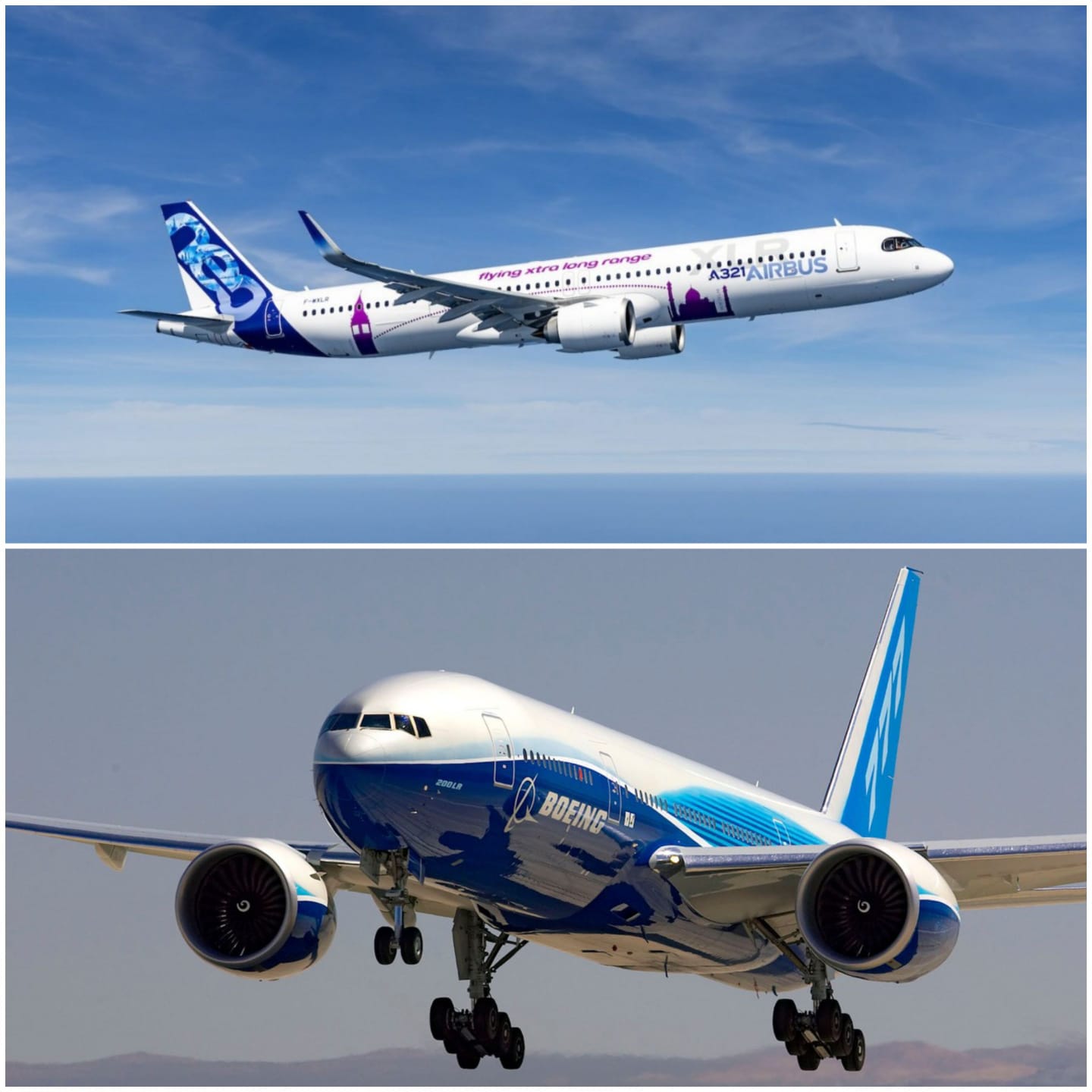
Perhaps Airbus and Boeing see enough greenery in the grass to no longer find it necessary to slag each other off as has been customary at air shows these past years.
This year at Paris, we might underscore the difference. Let’s just say it will be far more placid where these engagements are concerned. Aviation writers, by nature, are not combative. They might ask the occasional penetrative question but are not yet mentally kidnapped by the raucous call of social media. So, airshow press conferences are generally pleasant and limited by decorum, with perhaps the mandated slanging match between Boeing and Airbus being the ‘one-two punch’ of the proceedings. Even that has lost its charm and the once rush to get to an Airbus or Boeing press conference is a far more sedate affair, what with these sessions being rooted more in exchange of information than a jibe or mildly disguised snide remark.

It is unlikely that Dassault will be confronted by any questions on what the performance envelope of the Rafale was in the recent India and Pakistan conflict. To pick on this utterly pointless controversy would be seen as downright bad manners. It is also not germane to the occasion and if some representative of the diluted professionalism in the Press corps (courtesy social media) has the temerity to bring it up, he or she will be swiftly shushed. So they should be, since the issue is now well into the tedious category and to be in Paris, home of the Rafale and carp about the possible loss of a jet would be an act of lese majeste.
Let’s get to business. The Paris Airshow, one of the largest aerospace events in the world, often showcases the latest aircraft, the latest advancements in aviation technology and weaponry. And the rivalry of the giants is marked by a fair amount of progress and novelty.
The Boeing 777X is expected to make appearances, featuring advanced technology, larger capacity, and improved fuel efficiency. There will certainly be an interest if Airbus puts its A350 freighter on display. The accent will reflect advancements in aviation technology and sustainability. We should look at the Airbus A321 XLR, which is an extended-range version of the A321neo Family and should find a slot in long-haul operations. From the other side of the fence, the Boeing 737 Max 10, which will be the largest variant in the series, offers increased passenger capacity. From China, we’re looking at the C919, China’s narrow-body jet, which intends to compete with Western aircraft on the commercial side, so both Airbus and Boeing are going to be acutely aware of the challenge.
But wait a minute. The big deal of the show is going to be the 200 to 300 narrow-body and wide-body aircraft order from China for Airbus aircraft. This is a game changer, and the deal will probably be cemented before the air show is over. This is in keeping with Beijing’s new policy of coming closer to Europe and in terms of numbers and cost, it is quite a bit better.
Still not having recovered totally from the fallout of the 737Max disaster, Boeing’s future emphasizes the development of new aircraft models, including the 777X and the highly anticipated potential mid-market airplane. Boeing aims to invest significantly in sustainable aviation fuel (SAF) and advanced technologies to reduce emissions, aligning with global environmental regulations. Moreover, the company is enhancing its partnerships with suppliers and integrating digital technologies to streamline production processes and improve efficiency.
If Airbus has a full plate, Boeing isn’t exactly going hungry. It is thinking ahead towards the mid-level plane and the designated Boeing 797 will be a single aisle design aircraft, potentially seating between 290 and 295 passengers. Specifically aimed at replacing the elderly 757 and 767 fleets, Boeing looks at a potential market for 2000 to 4000 units and it’s also supposedly positioned to compete with the A320 and A330 families while maintaining efficiency and lower operating costs. It is also expected to utilize advanced composite materials and a new-generation, efficient turbofan engine for improved fuel efficiency.
With a range of around 5,000 nautical miles (9,300 km) for a 225-seater version and 4,500 nautical miles (8,300 km) for a 275-seater version. The New Midsized Plane (NMA) is expected to generate 30% more revenue than narrowbodies and have 40% lower trip costs than the widebodies it would replace. That is quite a saving and could find favor with new customers.
Boeing hopes it will compete directly with Airbus’s A320 and A330 families, as well as the Airbus A321XLR. The latter is already making waves. This narrow-body aircraft is designed to extend the range of the A321neo family. With a range of up to 4,700 nautical miles (8,700 km) and a flight time of up to 11 hours, it dramatically extends city pairings.
Both giants are going to be far more attentive to the reduction of carbon emissions.
More of the essence will be programs like CORSIA (Carbon Offsetting and Reduction Scheme for International Aviation) focus on carbon offsetting for international flights, allowing airlines to invest in projects that reduce carbon emissions elsewhere. Airbus is aggressively pursuing a sustainable future. The company plans to launch a hydrogen-powered aircraft by 2035, showcasing its commitment to zero-emission aviation. Airbus’s A320 family aircraft are undergoing modifications to accommodate sustainable aviation fuels, and the company is actively researching additional technologies to minimize the carbon footprint of air travel. In addition, Airbus is also expanding its presence in emerging markets and increasing production rates to meet the rising demand for air travel, particularly in Asia.
It has to be said that both the big boys are taking future trends seriously and have already begun work on them. Airlines and aircraft manufacturers are collaborating with energy companies to develop and certify SAFs for commercial use. New aircraft designs, such as the Airbus A350 and Boeing 787, incorporate aerodynamic enhancements and lightweight materials, resulting in better fuel efficiency. Ongoing retrofitting of existing aircraft with more fuel-efficient engines and winglets is already underway.
A more earnest and in-depth assessment and analysis of the market trends is of the essence.
Financially, the sun is shining a little brighter on both companies. Boeing faced significant challenges, particularly with the grounding of the 737 Max in 2019 and the impact of the pandemic on air travel, compounded by supply chain fractures. Things have been better since 2021 and there is a recovery effort to get back at least some of the billions that were lost. Just 2020, Boeing reported losses of $11 billion. In 2021, revenue increased to $62 billion and there is a renewed belief that the worst is over. Airbus won this fiscal race with a far steadier performance. It was profitable in 2020 thanks to the prodigious global demand for the A320 family options and that increased to 611 sales in the following year.
If we project the fortunes of the two companies into 2030, we can predict an upward climb. The market is there; more people will be flying and the potential for sales is immense and tangible.
Market demand remains a key factor, with the Asia-Pacific region expected to lead to growth in air traffic. As airline fleets expand, both manufacturers will compete for orders. Ultimately, the competition will hinge on innovation, sustainability efforts, customer satisfaction, and adaptability to evolving industry standards, making the race between Boeing and Airbus one of the most dynamic stories in aviation. The next decade will undoubtedly shape the future of global air travel.
Both companies are also investing heavily in defence and space sectors, as military and commercial aerospace opportunities continue to evolve. It is a wake-up call for both companies and the operative word is sustainability and lower costs. The future for Boeing and Airbus will be shaped by their ability to innovate, respond to environmental challenges, and adapt to the shifting global aviation landscape. By focusing on sustainable practices and new technologies, both giants aim to lead the way in revolutionizing air travel for generations to come.
Bikram Vohra is the Consulting Editor of Indian Aerospace & Defence.


